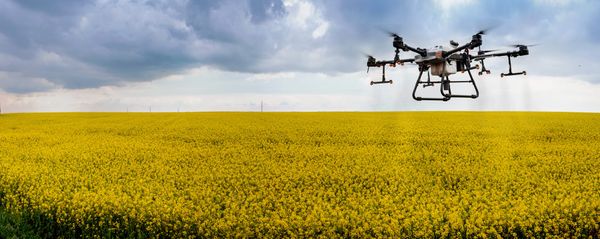
With new rules allowing the use of drones for pesticide application, supporters say there are huge benefits for agriculture, enabling more precise and efficient pesticide use.
While the ultimate objective of engineering more efficient tools is often to curb consumption and foster environmental sustainability, the history of technology warns of a counterintuitive twist. Sometimes, when a tool becomes hyper-efficient, the exact opposite unfolds.
Cameron Shelley, a professor of systems design engineering at the University of Waterloo, routinely introduces his students to this exact phenomenon, known as Jevons’ paradox. Named after 19th-century economist William Stanley Jevons, the theory suggests that increases in technological efficiency ultimately drive up total consumption rather than lowering it.
“Which seems paradoxical. So that’s why it’s called a paradox,” said Shelley.
“You would think if you make consumption of something more efficient, you get less consumption, but the opposite is true.”
Several years ago, Shelley authored a paper exploring how this economic anomaly might collide with cutting-edge agricultural innovations, specifically the deployment of pesticide-spraying drones.
“I was reading this article about how drones can make pesticide application more efficient. Instead of broadcasting pesticides across the whole field regardless of where it’ll land, you can have a drone that will pinpoint places to apply pesticide and apply less of it, and so be more efficient,” explained Shelley, adding that while he was reading that he thought, “well, it’s not always that simple.”
On paper, the precision offered by drone technology is overwhelmingly positive. It lowers overhead costs for farmers and reduces the chemical pollution load on local ecosystems – all things Shelley points out in his article.
Over time, those reduced operating costs could even trickle down to consumers, making food cheaper at the grocery store. However, market dynamics dictate that as a process becomes cheaper, demand tends to surge. This is where Jevons’ paradox takes root. The phenomenon is well documented across various modern advancements, with air travel as a prime example.
“Studies show air travel has become more efficient. So, between the 1960s and now it costs a lot less to move a passenger, let’s say a kilometre through the air, because jet engines have gotten more efficient,” said Shelley, adding that as the air travel industry has become more efficient, the cost has lowered and more people have been using the service.
Shelley clarifies that highlighting this paradox is not an argument against technological progress or engineering innovation. Instead, it serves as a warning to slow down and critically examine the long-term systemic goals of efficiency.
“Engineers love efficiency. They’re often focused on making a particular piece of technology more efficient, and not thinking about the consumption of that technology,” said Shelley.
Complicating the matter, consumer behaviour is often driven by desire rather than strict necessity. The smartphone industry is a testament to this, with annual upgrades that make the technology more efficient, constantly compelling consumers to throw away perfectly working phones in favour of the newer, shinier model.
When it comes to altering patterns in human behaviour or balancing sustainability with efficiency, engineering has its limits.
“There probably isn’t an engineering solution, right? And the problem is how people consume things, and that’s more of a social issue, not something that you can design,” said Shelley.
Ultimately, whether drone use in agriculture will succumb to Jevon’s paradox remains an open question.
In his article entitled “Drones, Crops and Jevon’s paradox,” Shelley himself wrote he was unsure: “I do not know if adoption of drones in agriculture will have these effects. The agricultural system is too complex to warrant sweeping conclusions from a few musings.”
As technology makes our lives increasingly efficient, ideas like Jevon’s paradox are something Shelley advocates his students consider. For the next generation of engineers, understanding the human element may be just as important as perfecting machines.